

3 Decisions That Define Your Creator DNA
A framework for understanding who you are and what you naturally do best


There’s a crazy game going on out here in these internet streets, but I don’t think it’s a lack of talent that’s making creators feel lost.
It’s because they don’t know who they are to the audience they’re trying to attract.
Are you here to entertain or to educate? Do you want people to trust your proof, or your lived experience? Is your business built on quick transactions, or delivering a real transformation?
If you can’t answer those questions, you’re rolling the dice every time you hit “publish.”
And gambling is not a strategy for long term success.
I know first hand how easy it is to get caught up chasing metrics that don't match your natural alignment. Spending a bunch of energy aiming yourself at the wrong audience, just to get exhausted trying to force things that come easy to creators with different DNA.
This is what I've learned after a year of building my own creator business and deep diving a hundred other ones: There’s three fundamentals that will tell you everything about how you should create, who you should serve, and how you should monetize.
These are not labels to tie yourself to - they're foundations to build from. Instead of trying to be everything to everybody, you can be exactly what your people need.
The Framework
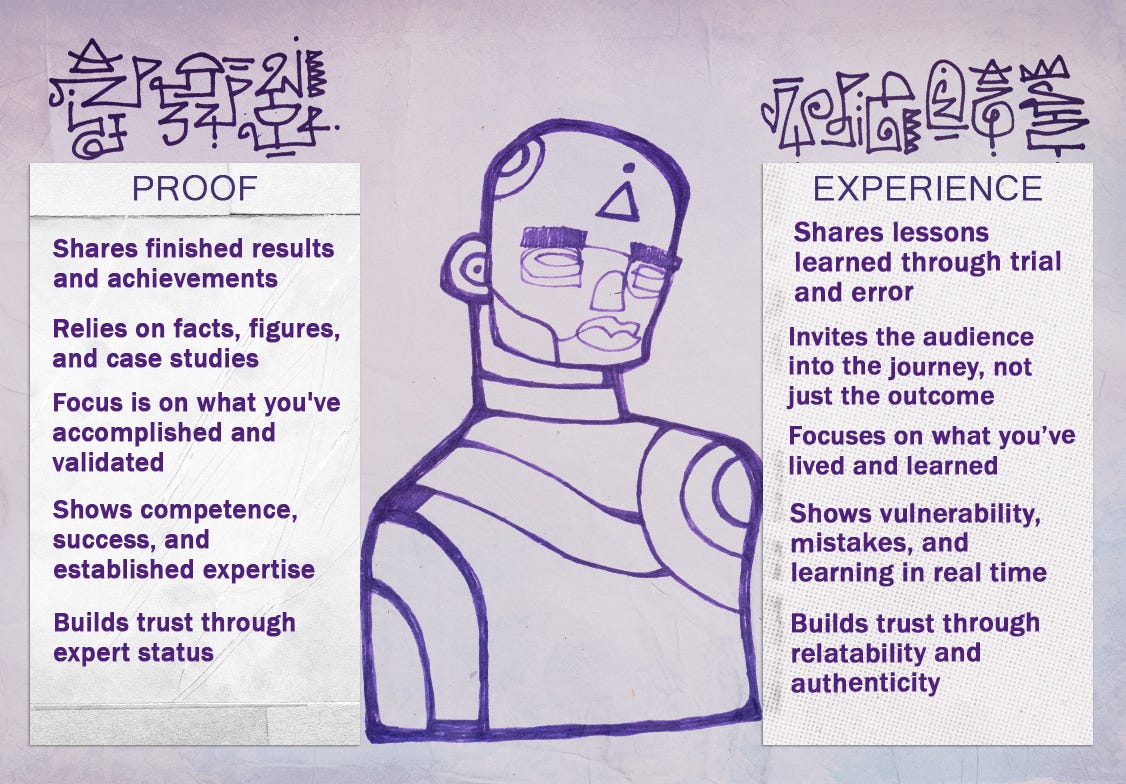
The first alignment explains how you intend to build trust.
Are you leading with your journey or your achievements?
Experience-based creators invite the audience into their process. They share vulnerability, mistakes, and real-time learning. They build authority through relatability and authenticity, showing what they're discovering instead of what they've mastered.
Proof-based creators usually share finished results. They use facts, figures, and case studies to show their credibility. They build authority through expert status, keep the messy parts behind the scenes, and focus on the best outcomes.
Both ways can attract an audience and build trust. But they attract different types of people who want different types of relationships.
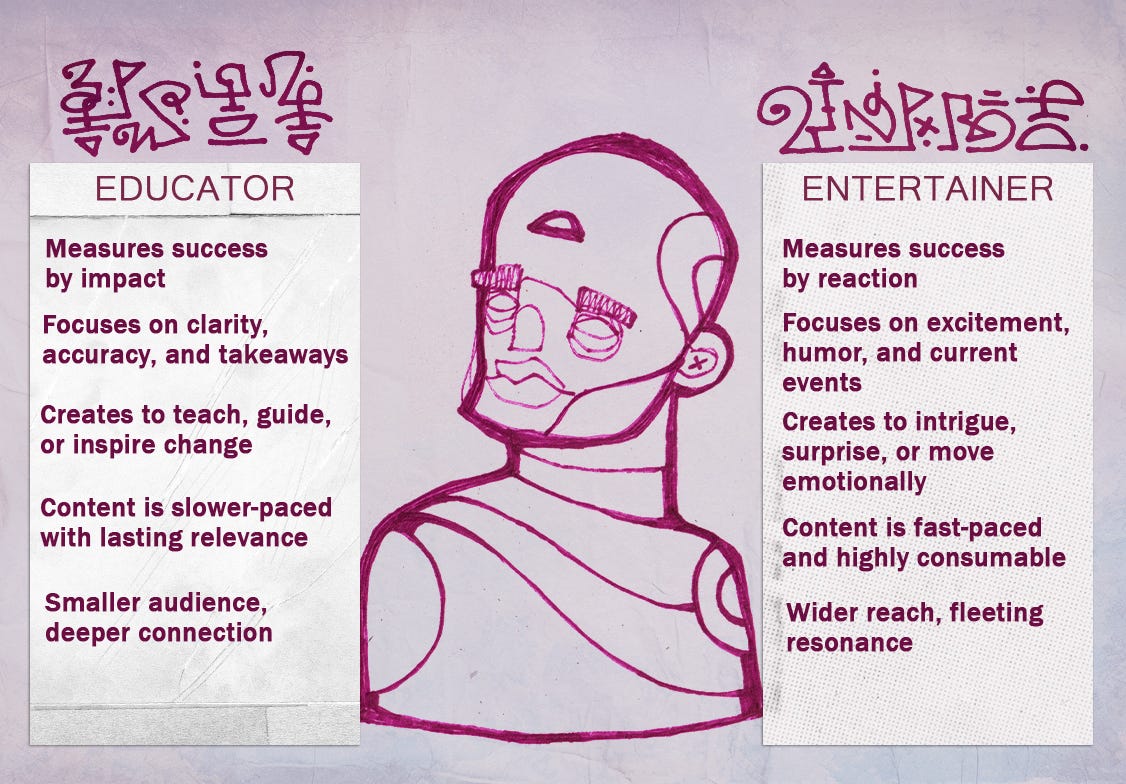
The second alignment is about how you show up.
Are you more drawn to impact or reaction?
Educators create to teach, guide, or inspire change. Their content will usually be more relevant over a longer period of time. They build deeper connections with smaller audiences. And their success depends on understanding, so they focus on clarity, accuracy, and takeaways.
Entertainers create to move people emotionally in the moment. Their content is fast-paced more consumable. It reaches wider audiences but usually with short lived resonance. Their success comes from immediate gratification, so they focus on excitement, humor, and current events.
Again, both work. But if you're naturally an educator trying to chase entertainer metrics, you'll burn out. And If you're naturally an entertainer trying to force an educational presentation, you'll lose interest.
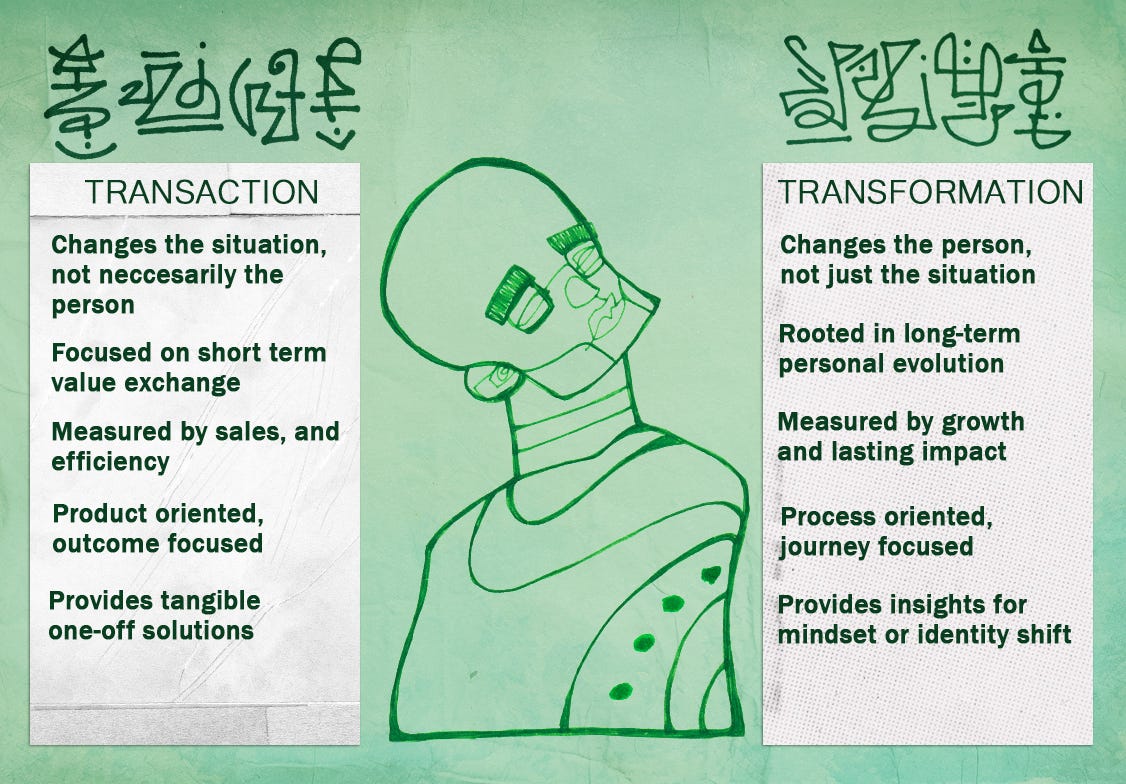
The third alignment describes how you deliver value.
Are you changing the situation or changing the person?
Transaction-based creators focus on quick wins. They deliver tools, tips, and shortcuts that solve immediate problems. Their content is built around products, their growth depends on volume, and success is measured in speed and efficiency.
Transformation-based creators prioritize long-term growth. They guide people through mindset and identity shifts. Their content calls for deeper engagement, their business models scale through closer relationships, and they measure success by impact over time.
Both approaches work. But they need completely different content strategies, audience development, and business models.
In all three of these decisions, most people make the mistake of trying to be both at the same time.
Finding Your Position
Of course we can do elements of both, but when you know your true alignment, all your decisions get easier. Content ideas, audience development, pricing strategies, partnerships - everything flows because you're working with your grain, and not against it.
I'm an experience-based educator focused on transformation. That tells me:
Share my process, not just my outcomes
Create frameworks that shift thinking, not quick fixes
Build deeper relationships with fewer people
Focus on long-term impact over short-term engagement
You don’t have to put yourself in a box.
But you do need to understand your foundation. If you can state your position clearly, in all three categories, you can build strategically instead of randomly.
The Integration
Creator DNA sounds cool, but it really is a framework for making informed decisions about who you are and what you’re willing to offer.
Stop chasing strategies that don't fit.
Stop comparing your behind-the-scenes to other people’s highlight reel.
Stop trying to force it and learn how to flow in your natural currents.
Find your DNA. Build from there. The world doesn't need another version of the people you follow - it needs this version of you.
This is the way.
Sometimes these frameworks click immediately. Other times it takes conversation to see things a little more clearly. If you’d like to walk through some of these ideas together, I offer 1-on-1 calls where we map things out and figure out the next steps.
You can start here: [A Few Questions]
If any of this resonated…
Check out something from the archive:

Check out these downloadable Asemic Icons!
Feel free to download and use them for rituals, design, collage, intuitive journaling, or whatever comes to mind. Tag me if you do, I’d love to see how you use them.
All hand drawn, Hi res, transparent PNGs. Have fun!
This newsletter is free because I practice my kung fu in the front yard.
In other words, I believe in sharing the process, not just the results.
If you’d like to support the work:
Subscribe (free or paid, either one helps this grow)
Donate (every dollar helps buy back creative time)
Thank you for reading, and for being with me on this journey.
You are greatly appreciated.
— Corey
I love this! So very helpful, especially in a society that seems to overvalue the proof, entertainer and transaction side of things. I think I'm naturally an experience, educator and transformation person, but have felt a lot of pressure to be the opposite.
Useful